Thursday, 21 January 2021

Present Continuous: Verbs with -ing

 Suitable for beginners CEFR A1+

 #PresentContinuous #EnglishGrammar #Tenses #grammar


 events, agenda, appointment, calendar, computer, connection, copy space, coworking space, date, day, deadline, design space, desk, desktop, device, digital, display, drink, electronic, headphones, internet, laptop, management, meeting, mockup, monitor, music, network, notebook, organization, organize, organizer, plan, planner, planning, playlist, portable, reminder, schedule, screen, smartphone, technology, time, to do, product, font, electronic device, coffee cup, metal, office equipment, brand, drinkware, logo, personal computer, tableware, cup


Use present continuous to talk about things happening in the present moment, right now or things that you have made plans for in the immediate or near future.


To make sentences in present continuous use: 


             am/is/are (not)  + verb + -ing 

For example:

Where is she?

                        She's walking the dog. 

What's he doing?

                            He's doing his homework. 

Are you giving me a pay rise?

                                                I'm not giving you anything.

What are you doing?

                                  I can't talk right now. I'm having a shower. 

Are they coming to the party?

                                              They aren't coming to the party later. 


Notice that in the interrogative (question form) the pronoun and the verb 'to be' switch places. 

So, now you know how to make sentences and questions using present continuous, try these activities to test your knowledge: 


Activity 1

Complete the sentences with present continuous.

1. ________ you _________ dinner? (have)
2. Stop, you____ _________ a mess! (make)
3. I____ ________ him at the cinema at 7pm. (meet)
4. ____ he _________ on holiday with you next year? (go)
5. He___ not _______. He isn't hungry. (eat)


Activity 2

Make your own sentences in present continuous to describe what is happening in the picture.

File:Rex Barber - Peppermint Grove Beach cartoon.png


Activity 3

Write about what you are doing today/tomorrow or right now in present continuous or go to your local park and describe what is happening there.

Some useful verbs to use are:
be
do
make
have
go
play 
eat 
drink
clean
stay
take
meet
travel
wear 

Write your answers in the comments! See you again soon for another FREE English lesson


Thursday, 7 January 2021

Most Common Language Learning Myths Debunked

 Suitable for low-intermediate CEFR B1+ 

#Languages #LanguageLearning #polyglot 


Language is everywhere. It is fundamental to every thought and social interaction we have throughout our lives. It is something that we all learn as children having had no previous experience and without explicit instruction, and yet many people are filled with tremendous anxiety at the very idea of learning a new language.

There are many myths and false beliefs that people may hold about learning a language, sometimes simply because they are prevalent in society and sometimes as a result of our own self-doubt. So, for all the people thinking about learning a language or thinking of giving up, here are 5 of the most common language learning myths debunked. 


1. Learning a language requires a special talent 

Whilst it is true that there are some polyglots out there who do seem to have a natural gift for learning languages, learning a new language does not require any special skills or talents; all you need is determination. Language learning is a gradual process and building fluency depends on putting in effort and communicating at regular intervals. Anyone can learn a language if they are willing to put in some hard work and can set aside 15-30 minutes several times a week.

If you failed at learning a language in the past, it is likely that you weren't doing the right things regularly enough. Making some changes to the way that you learn or how often you learn could help you get better results. 


2. New technology means there's no need to learn a language

Anyone that thinks they can use Google translate or some other translation app hasn't tried reading the auto-subtitles on You Tube! Anyone that has will know that language software has a hard time generating subtitles in the same language as the speaker, let alone translating to other languages accurately. Whilst the technology is admittedly much better than it was 10 years ago, voice recognition software still struggles with regional accents and automatic website translations are often littered with errors or, in some cases, end up completely unreadable.

'So what?' a skeptic might say, 'give it another five years and the technology will be more reliable.' That may be so, but communicating effectively is more than simply speaking a language. To really communicate in any language you need to feel it in your heart. 

Each language, however similar, has its own nuances that create emotional connections that speakers can identify with and use to build stronger relationships. Communicating through a computer programme adds a physical and emotional barrier that will never replace the need for language learning.


3. You can teach yourself a language using books and apps. 

Don't get me wrong, there are some truly amazing language learning apps out there that are available for free (God bless the internet), but books and apps alone are not enough to learn a language fluently. Although books are great for completing grammar exercises to improve your accuracy, and Duolingo is a productive way to use 5 minutes of otherwise 'dead' time waiting for your bus to arrive, the purpose of language is communication and you can only do that with other people. For best results use as many different resources and speak to as many different people as possible.
 
Don't have anyone to speak to? Find a language partner for free on a language learning platform or take some small group classes with a reputable online school. 
 

4. I'm too old to learn a language.

File:Monolingual vs. bilingual aging brain.jpg - Wikimedia Commons

Evidence suggests that children under 7 can pick up languages easily because the brain has not yet fully developed and some theories suggest that there may be differences in the way additional languages are stored in the brains of young children, but the truth is that you are never too old to learn!  
 
With commitment and perseverance you can achieve anything you set your mind to. Set aside some dedicated study time each day or as much as you reasonably can each week and get yourself into the habit of learning. Generally speaking, little and often is better. Fifteen minutes of your full attention every day will make more of an impact that setting aside a whole hour twice a week and you're likely to notice your progress more quickly without it becoming a chore.


5. The best way to learn a language is to go and live in a country where it is spoken. 

Sure, immersion is a great way to become fluent in a new language more quickly, but with so much technology available to support communication it is by no means essential. The biggest factor at play here is motivation. When all of your daily tasks require you to speak another language, you become highly motivated to improve. Finding some way to replicate that may help you retain more information and to learn more quickly. 

Need some inspiration? You could try playing video or online games in another language or changing the language settings on all your electronic devices. Listening to international radio stations or audiobooks while you are travelling or doing other tasks is also an easy lifestyle change to make.


So that's it. Five of the most common language learning myths debunked.

Learning a language requires a lot of hardwork and commitment and it is human nature to find excuses for why we haven't gotten round to something. It is no easy task, but I hope you can see that with a little time and effort several times a week, it is possible to reach a functional level of fluency within a reasonably short period of time.  

If you are thinking about learning a language, go for it! Use as many different materials and resources as you can, many of which are available for free, so you've absolutely nothing to lose! 

If you have been learning a language and have become frustrated because you don't seem to be progressing anymore, think about how and where it is that you are studying. Sometimes trying a new way or choosing a different enviornment can make all the difference. Seeking support and advice from a fully qualified and reputable language teacher can also help kick-start your motivation and take your language learning to the next level.

You can book a 15 minute trial session and language assessment to identify gaps in your learning and set new targets for only $1 USD with me on facebook or via the contact form on my website.


Tuesday, 29 December 2020

5 Reasons Improving Your English Should Be Your New Years Resolution

Suitable for CEFR intermediate and above (B1+) 

 #ny2021 #nye #goodbye2020 #hello2021 #resolutions

New vocabulary is highlighted in bold.

With the New Year almost upon us, it is a time when many people choose to reflect upon their life choices, celebrate successes and reevaluate what is important to them. New Year's resolutions offer a perfect opportunity to set fresh goals for any missed targets, take up new hobbies or focus on positive lifestyle changes that you'd like to make. 


 Happy New Year - Free image on Pixabay


However, choosing your resolutions and breaking them down into more manageable step-by-step targets can be quite a challenge in itself, so it's no wonder that the majority of people who set New Year's resolutions are likely to have abandoned them by the end of January! 

One of the most common mistakes that people make is setting themselves overambitious and rigid targets, which often results in people believing that they have failed the moment they deviate from their plan. Making a positive lifestyle change is about building better daily habits and it is important to accept that this can be a slow process. Be kind to yourself and accept that you will have good days and bad days. It's not the end of the world if your schedule suddenly changes or you have an off day, but it can be a very slippery slope. For most people it's better to start small so that you can feel a sense of achievement, and this in turn is more likely to motivate and inspire you to do more. 

For those of you looking for inspiration or who haven't decided what your resolutions will be yet, I have put together a list of reasons why improving your English should be at the top of your list!


1. English is a global language 

English is everywhere! It is estimated that one in five people on the planet can now speak or at least understand English and it is widely used as a lingua-franca. As well as being an official language in over 50 countries, it is also the language of education and academia. The ability to speak English is now a requirement for entry to universities all over the world because many scientific journals and technical manuals are published first or solely in English. 


2. It can help you get a better job

Yes, English is a skill that is increasingly essential to employers as a way of improving communications within international organisations that have offices, departments or trade agreements in several countries. Having English qualifications on your CV makes you more desirable to employers and can help you get ahead of other applicants on the job market. 


3. English is the language of entertainment and media 

Despite recent increases in popularity of international films and TV shows thanks to online streaming and subscription services, Hollywood still dominates the entertainment industry with the vast majority of films, TV shows and music recorded in English. Improving your English means you won't have to rely on subtitles and bad voice dubbing to enjoy your favourite songs and movies.


4. English makes it easier to travel 

Whether you are working in Beijing or backpacking in Bali, English can help you meet and communicate with new people, access different cultures and find solutions to a whole host of problems commonly experienced by travellers.


5. English is not that difficult to learn 

No really, it's true! There are, of course, some annoying things about English just like there are annoying things about any other language. In English words are, for example, often spelt differently to how they sound and there are a lot of phrasal verbs, but the basic structure and grammar of English is relatively straightforward and easy to learn. This is because English, throughout the course of history, has lost its cases. There are only 3 cases in modern English: the subjective, possessive and objective. This means that there are fewer grammatical forms to learn than in some other languages, many of which have between 5 and 18 cases! 


The support of a qualified language teacher can help get you into the habit of learning and make your New Year's resolution to improve your English more achievable. A good teacher will always assess your learning needs and suggest reasonable targets to improve your communication skills over a set period of time. Having a deadline and someone to hold you accountable can work wonders for taking your English to the next level. 

Ready to begin? There's no time like the present! You can book a 15 minutes trial session and free language assessment with me on Facebook or visit my website for more information.

Wednesday, 25 November 2020

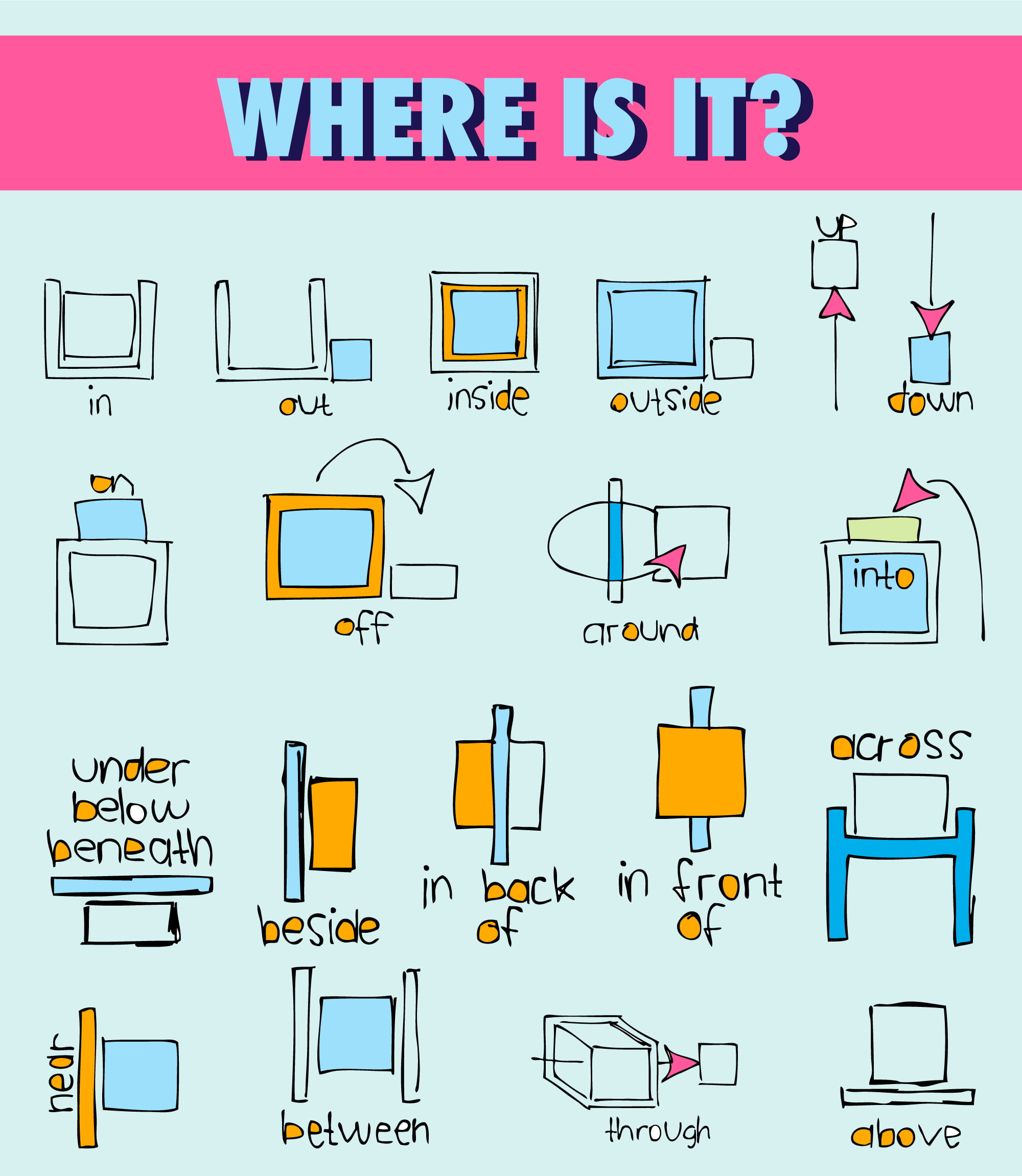
English for Beginners: Prepositions of Place

 Suitable for beginners CEFR A1+

Prepositions tell us the relationship between two or more people, places or things. Prepositions are commonly followed by nouns, noun phrases or pronouns

e.g. The cat is on the bed

There are over 100 prepositions in English! Some are single words and some consist of two or three words that are used together. This lesson is about prepositions of place, which tell us the location of something in relation to something else, or where something is. 


5 Types of Prepositions: An Easy Guide – INK Blog


Activity 1

Complete the sentences with a preposition of place.


400+ Free Living Room & Room Illustrations - Pixabay


1. The pink chair is _________ the fire. 

2. The logs are _____ the basket. 

3. A glass of wine is ____ the table. 

4. The desk is ___________ the window. 

5. The blue flowers are ___________ the desk and the wardrobe.  

6. There are some books ____ the desk ______ the lamp.  

7. The pink chair is _______ the footstool. 

8. The footstool is __________ the pink chair.  

9. The rug is ________ the small table. 

10. The picture is ________ the fireplace.  

11. The ocean is  __________ the window.

Friday, 20 November 2020

20 FREE Ways to Learn English at Home during a Pandemic

Suitable for low intermediate CEFR B1+

Are you wondering what you can do with your time if you are socially isolated in the middle of a pandemic? You can use this time productively to improve your English, of course! Here are my top 20 socially distanced ways to learn English completely for free at home, not just for the pandemic, but always. 

Please note that this post is not sponsored and I am in no way affiliated with any of the organisations mentioned here, any links provided are for resources I have personally found useful in helping others learn English. 

See the source image


1. Watch a TV show or movie in English with or without English subtitles

Watching TV shows or films with or without subtitles is a great way to improve your English at B1 level and above. However if you are using subtitles, you should always have them in English. Using subtitles in another language is distracting and makes it very difficult for your brain to process new information when you are trying to focus on the language.

If you are a beginner or A2 English learner I recommend watching shorter video clips on YouTube so that you can pause and replay scenes to write down new vocabulary or phrases and do not tire too quickly.


2. Play Duolingo with your friends

Duolingo is a game-based mobile app for language learning and it is very effective for increasing your vocabulary at A1-B1 and revising grammar structures to improve accuracy at B1 and above. You can even invite your friends and learn with them.

Duolingo are adding listening and reading lessons for some languages including English, which makes it a perfect platform to maintain your English skills in 10-15 minutes per day if you aren't using the language in your community every day.

There are, of course, many more great language learning apps on the market that you can use alongside Duolingo. The more the merrier!


3. Change language settings to English on all your electronic devices
 
Tablet,screen,monitor,phone,pc - free image from needpix.com

This one is so obvious, but is often overlooked! Changing all your language settings is absolutely free and something very easy that you can do to immerse yourself in a language in the digital world. It may be inconvenient at first if you are unable to understand an error message that pops up on your computer, but with a little perseverance you will soon get used to it.


4. Complete a free lesson on my blog

If you've read my blog before you will know that it is created with English learners in mind. Every lesson is gradedto a particular CEFR level and many include free activities designed to accelerate your English learning and help you reach your desired proficiency.


5. Watch a YouTube video

There are literally thousands of videos suitable for English learners available on YouTube. The best thing about YouTube is that the algorithms highlight videos that you may like depending on your viewing history. Once you start watching English videos on YouTube you are bound to find something focused on your particular interests.


6. Listen to an English radio station
 
Old Radio Electronic Antique - Free vector graphic on Pixabay

Many mobile apps allow you to listen to radio stations from around the world. Find one with your favourite music genre and put it on whilst doing the housework or on your commute to up your language immersion during 'dead' time.


7. Use Cambridge Write and Improve

Cambridge write and improve is a website that uses artificial intelligence to read your writing, highlight potential errors and suggest improvements. Students preparing for IELTS or other English exams may find this website particularly useful as it uses questions similiar to those that you might encounter in real question papers.

The software isn't perfect and results requires some interpretation, but if you can't afford to hire an English teacher, it is a great way to help yourself notice errors and improve your writing style. If you have trouble interpreting errors you could even consider posting on a language learning community forum like italki for some suggestions from native speakers and other English learners.


8. Learn a new word from the dictionary

The average person spends a whopping 61 to 161 hours per year on the toilet! If you are one of those people that likes to keep some reading material in the bathroom, opening the dictionary and finding a new word is a great way to spend all of that time.

Try reading the word aloud and noticing whether the word is a noun, verb, adjective, preposition or conjunction. Many dictionaries also provide sentence examples that can give you an idea of how to use the word in conversation. The Cambridge English Dictionary Online is a trusted source, which can also provide translations into other languages.


9. Watch a TED Talk

TED is an amazing resource for language learning! Not only can you find professional and academic presentations on a variety of interesting topics, but you can also download the transcriptions to read while you listen or to highlight new vocabulary or use of grammar afterwards. You might even learn something new about the topics you choose!


10. Download and listen to an audiobook
 
Headphones Listen To Music - Free image on Pixabay

Audiobooks are perfect to listen to whilst traveling, exercising or simply doing the housework. First listen to understand the gist of a story then listen again while reading along with the eBook. At the end of a chapter you can go back and highlight new vocabulary and useful phrases.

There are plenty of apps offering paid subscriptions for audiobooks, but it is always worth checking your local library for free English language audiobooks. Many libraries now have extensive online services with audiobooks and eBooks you can checkout and listen to on your mobile devices without having to step foot inside a library.


11. Reorganise and revise your English notebooks 
 
File:Notebooks and journals.jpg - Wikimedia Commons

Language learning notebooks can get messy very quickly, especially as you are working out which study methods work best for you. Some people prefer lists and some people like to be more creative, but generally speaking the more you reorganise information, the easier it will be to remember. If you're feeling bored or at a loss for what to do, taking time to try out different presentation styles is always time well spent.


12. Teach someone else
 
Free Images : teacher, family, parenting, together, people, child, father,  happy, parent, happiness, kid, education, childhood, love, smile,  togetherness, teaching, school, books, learning, toddler, play, fun, human  behavior, reading 3100x1800 - mohamed

My favourite school teacher once told me that you never really know you understand a topic until you can teach it to someone else, and being a teacher myself, I can truly appreciate the value of this advice. Sharing your English knowledge with your children, family or friends will make you more aware of what you don't yet know so that you can focus on filling those gaps in your repertoire.


13. Take an online class
 
100+ Free Online Learning & Webinar Illustrations - Pixabay

Online courses have boomed with more people staying at home and taking up new hobbies since the pandemic began. You could opt for a free MOOC if it's just information you want, but for communication practice you'd be better off finding a small online class or having 1:1 tuition with a language tutor. Many companies have a maximum of 8 students per class, which is perfect for practising new phrases and expressions, but taking a private class will offer the most speaking time and your teacher will be on hand to correct any errors. 


14. Find a language partner on italki

This option is great if you have a tight budget or your financial situation has changed during the pandemic. Finding a language partner on italki is completely free. All you have to do is find someone that speaks a language you want to learn and offer to teach them the language you speak. You could, for example, arrange to meet up for an hour on Skype and spend 30 minutes speaking one language before swapping to the other. The biggest problem with this is that not everyone is serious and it may take a long time to find someone as dedicated to learning as you are. You may find yourself wasting time waiting for someone online that never shows up, but if you find someone reliable, it could save you a small fortune in tuition fees. 


15. Read a book appropriate for your level
 
Shelf Books Icons - Download Free Vector Icons | Noun Project

There are an increasing number of graded eBooks written especially for language learners available from online retailers like Amazon and they are often very affordable. A decent intermediate English eBook may cost anything from 99p to £4. There are also loads of great reading and listening apps you can download onto your mobile phone, with limited content available for free and access to wider content available for £10-20. 


16. Make revision cards on Quizlet

Quizlet lets you memorise information with all the benefits of using flashcards without having to carry them around with you. Making your own revision cards is a great way to spend travelling or commuter time productively for language learning. 


17. Do a quiz or create your own and invite your friends on Kahoot

This is a fun way to form a virtual study group. Kahoot lets you make your own multiple choice questions and invite your friends to compete against one another for the top score. 


18. Join a Learn English group on social media

Some groups are better than others because they have more active members that start interesting discussion threads or post regular helpful learning content. Beware though, many users have a relatively low level of language knowledge and do not communicate in proper English. 


19. Read the news 
 
Download free photo of The gap message,alarm,breaking news,news,urgently -  from needpix.com

Local and national news is available in English in many countries around the world. If you are interested in British or American culture, reading newspapers from those countries could offer a different perspective and help you improve your vocabulary. The Independent, BBC News and Sky News are suitable British newspapers for intermediate readers, or CNN and NBC news from the USA. 


20. Record yourself speaking about a topic and listen to it later
 
unused black micxrophone, audio, big, broadcast, equipment, external, film,  industry, media, mic | Pxfuel

No fancy equipment needed! Simply use your mobile phone's built-in microphone to record yourself speaking about a topic. This is great for building your fluency and speaking for between 2 and 5 minutes continuously, which can help prepare you for speaking examinations like IELTS and FCE. Listening to your recording later can help you notice grammatical errors in your speaking and any repetition, which you could replace with synonyms. You could also ask a friend to listen to your recording and respond to it to see if your recording is easy to understand. 


Wednesday, 19 August 2020

10 FREE Activities to Keep Kids Busy in the School Holidays

 Suitable for intermediate and above CEFR B2+

#childrensactivities #kidsactivities #summerholiday #staycation #kidssummer 


If your travel plans have been adversely affected by the coronavirus pandemic, the family holiday you've been looking forward to has been cancelled or lockdown has left you with a reduced income or financial worries, you're not alone! So many families have been affected in the UK and internationally and as a teacher, I understand that keeping children entertained on a budget is no easy task, but you needn't feel like a bad parent if money is tight. This post lists my top ten FREE activities to keep children busy and entertained during your summer staycation. 


10. Go on a nature walk 

If you've been walking more with the family during lockdown, taking a bag with simple supplies like a camera, some paper, crayons, a magnifying glass and some recycled glass jars can easily turn a quick walk into a whole morning activity that everyone can enjoy. 

Visit by Busy as Bees Nursery to Garthorne Road – Nature ...

Stop and investigate different trees and plants, take bark and leaf rubbings and hunt for minibeasts with your magnifying glass, using old glass jars or a clear plastic cup for a closer look. Spending time looking up the name of the creatures, writing a list, taking photos and finding some interesting facts online is a great way to embed a little educational content and it can also extend the activity when you get home.

It is, of course, a good idea to plan a route around your local area that passes a variety of habitats, such as woodland, fields and hedgerows, but you'll be surprised how much you can find in urban habitats too. 


9. Take a dip, have a water fight or set up a slip and slide 

If its warm outside and you already have a paddling pool or set of water pistols, this one is an absolute must. But have you also considered setting up a slip and slide with things you already have in your house? 

Slip and Slide Fun | Having fun in the sun on the slip & sli ...

Any area of grass will do for this activity but ground with a slight gradient may work even better. All you need is some heavy-duty plastic sheeting and lots of soapy water.

Keep your child's safety in mind. Always use smooth plastic sheeting without any seems and keep pouring water on to avoid painful friction burns. Check the ground for any protruding rocks or stones that could cause injury and build a crash barrier with pool noodles fixed with duct tape, velcro or ground hooks. A couple of yoga mats could be used as liners underneath the plastic sheeting if the ground is very hard, but be sure to secure everything properly to avoid injury.  


8. Summer Reading Challenge 

Kids,reading,book,child,kids reading - free image from needpix.com

Many community libraries run summer reading challenges to keep kids in the habit of reading over the holidays and the best part is that you don't even need to visit the library to take part! Check your library's free eBook and audiobook catalogue to download as much children's literature as possible. Audiobooks are especially great for children that like to be active as they can listen whilst colouring, digging in the garden, playing with Lego or doing some other low-level activity. 


7. Fruit picking 

 File:Blackberries by Hanney Road - geograph.org.uk - 1469378.jpg ...

There is an abundance of fruit growing by the roadsides at this time of year, take a bag and look out for juicy ripe blackberries, apples, pears and plums to harvest. Turn this into a whole day activity by going to buy ingredients to make jam or a pie. The children could even decorate jam jars to give as gifts.


6. Take a bike ride

When I was a kid I loved going out on my bike! Back then there was a lot more green space and less traffic on the roads, but you can still make good use of country parks, cycle lanes and wide pavements to take your children on a two-wheels adventure. Use a sports watch or mobile phone to map your route and count your miles. You could even create your own map to put up on the fridge where you can stick pictures of famous landmarks to target miles!


5. Camp in the garden

 grass, summer, nature, leisure children, play, tent, play tent ...

This is an old favourite. Get the old tent out of the garage and let the kids sleep outside for the night. Have a BBQ and breakfast outside (whatever the weather) and play some garden games, like badminton, bowls, rounders or cricket, to bring a few more holiday touches to your home.


4. Put on a fashion, dance, magic or puppet show 

Children of all ages love to put on a show. Encourage their creativity and nurture their talents by helping them to put on their own performance. They will love showing off what they've done and they might even teach you something new!


3. Make a stop motion animation video 

DSC00710 | Plasicene Zombies from a film using stop-motion a… | Flickr

Kids these days are very tech savvy. If your child is spending too much time watching videos online, encourage them to make their own stop motion animation! All you need to get started is a mobile phone with a camera function. 

You can be as creative as you like by painting an old shoebox to create a background or making characters out of plasticine or craft materials, but sticking some googly eyes on a piece of fruit can work just as well!


2. Get cooking

Free Images : boy, home, young, food, cooking, color, kitchen ...

This is a great choice for a rainy day. Most children love making a mess in the kitchen, but with a bit of guidance they can learn an important life skill too. You could support your kids to design a menu, go shopping for the ingredients (don't forget to give them a budget and let them do the maths!) and then make a 3 course dinner to serve the whole family. Not only will they love eating their creations, they will get a real sense of achievement seeing others enjoying what they have made. 


1. Set up a mini Olympics

 Chloe's field day games | Loren Kerns | Flickr

If you've got enough garden space, you can set this up at home, but a local park would be fun too. You can set up several classic events with minimal equipment. Long jump and running require only a stopwatch and a few items to use as markers. You could also do a discuss throw using a frisbee and target shoot with a bucket and a ball or nerf guns. You could also set up mini events using any sports equipment you already have, or throw in some sports day classics, such as the egg and spoon, wheelbarrow and sack race for extra family fun! You might also invite other families to join in if you're in a local park or with your virtual olympics from their own garden and post videos to each other and create a leaderboard so your mini athletes can 'compete' against each other.

If you have kids of different age groups consider handicapping events to avoid arguments. 


Wednesday, 5 August 2020

Future Simple

Suitable for beginners CEFR A1+

#grammar #futuresimple

Crystal Ball with Hands | Free SVG


Use future simple to talk about or make predictions about things that haven't happened yet.

19: Timeline: The Future Simple | Download Scientific Diagram

To make affirmative sentences in future simple use this structure:


will  +  bare infinitive

For example

We will go to Italy on holiday next year.
I will do my homework later.
She will have her first piano lesson on Monday.
It will be cold and dark in the UK in January.


To make negative sentences in future simple use this structure:


will not (won't) + bare infinitive

For example

He won't arrive until tomorrow.
They won't make it. 
It won't be possible to order it until Monday. 
The children won't eat spicy food. 


In the interrogative (question) form will/won't and the subject change places:

For example

Will there be food at the party?
Won't it be very cold there in January?
Will you come over later?
Won't he want any dinner?

So, now you know how to make sentences using future simple, try these activities to test your knowledge:


Activity 1

Complete the sentences with an appropriate form in the future simple.

1. ______ robots ________ teachers in the future? (replace)
2. How many grandchildren do you think you ______ _______?
3. ________ your brother ______ here soon? (be)
                          Yes, he _______.
4. She didn't eat her lunch today, so I think she _____ ______ hungry later. (be)
5. Do you think people ______ ________ on mars in the future? (live)


Human mission to Mars - Wikipedia

Activity 2

Make your own sentences in future simple with the following words.

1. long summer / be / this year
2. shopping / tomorrow
3. a prize / for the winner?
4. Flight BA147 / depart / from gate C5 / at 10.15.
5. Maybe / rain tomorrow / maybe / or


Activity 3

Write about what you think life will be like 50 years from now. Make predicitions using future simple.

Some useful verbs to use are:
be
do
make
have
live
replace
travel

Write your answers in the comments! See you again soon for another FREE English lesson


Stop Saying VERY! Use These Advanced Adjectives to Instantly Improve Your English Fluency

 #vocabulary #English #ielts #ieltsprep #ieltsspeaking   Very is one of the most overused words in the English language and the worst thing ...